
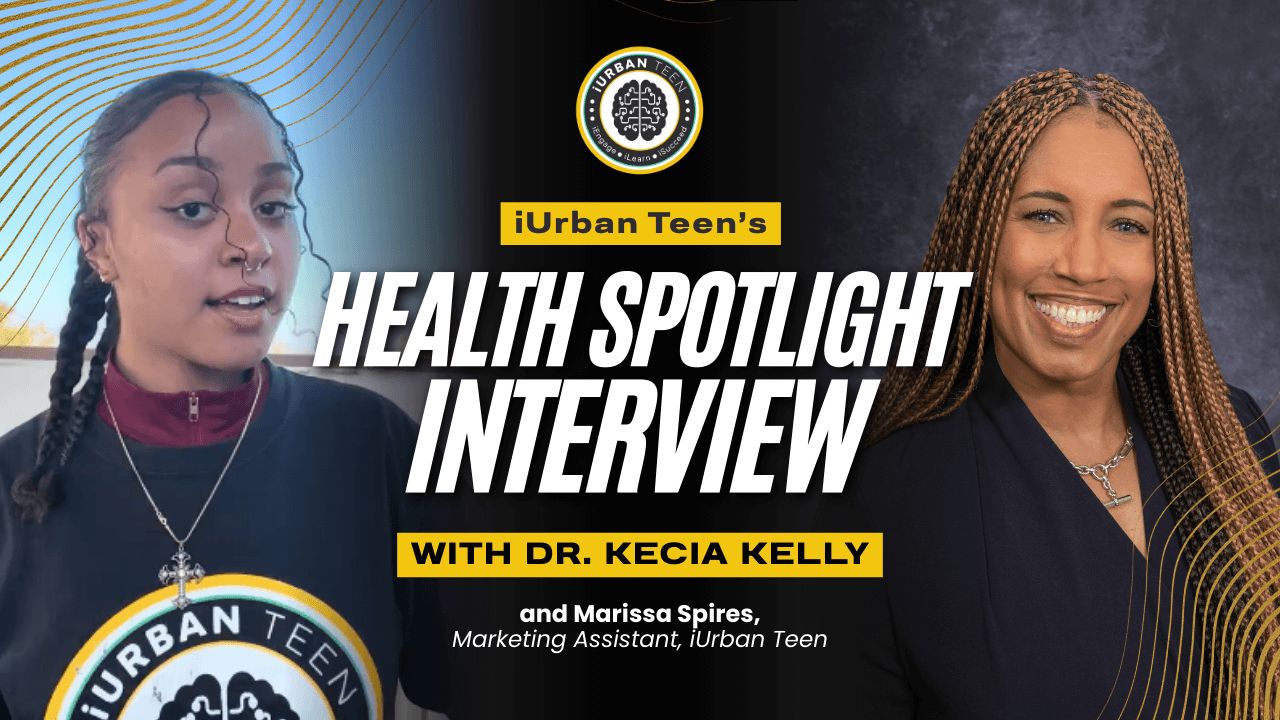
Marissa: All right. Hey, everyone, I’m Marissa Spires. I’m a marketing assistant for iUrban Teen, and today I have the exciting opportunity to interview Dr. Kecia Kelly for our iUrban Teen Health Spotlight.
Dr. Kelly is a DNP, MBA, FACHE, NEA-BC, and has built a remarkable career grounded in service strategy and a relentless commitment to patient-centered care, from her early days as a commissioned officer in the United States Army Nurse Corps to her current role as Senior Vice President and Chief Nursing and Philanthropy Officer at Legacy Health. Today, we sit down with Dr. Kelly to explore the lessons that have shaped her leadership, the challenges facing health care, and the enduring values that drive her work.
Again, Dr. Kelly, thank you for joining us.
Dr. Kelly: My pleasure.
Marissa: All right, let’s get into it. So, I sent you a few questions, but we’ll start with the first one. Very simple. What’s one core value that guides every decision you make as a health care leader?
Dr. Kelly: Integrity.
And I use integrity because, when we think about integrity, Marissa, you know, we think about integrity as being honest. There is a component of integrity about being honest. But there’s also a notion of integrity around following through on commitments and things that you say you’re going to do or that you’re not going to do, and here’s why. I’ve learned over the years that integrity is what improves workability.
People want to work with someone who can be counted on to follow through on their commitments. There are also people who can be counted on, and if, for some reason, they can’t follow through or there’s a delay in that follow-up, they will communicate that. That’s why integrity is very important to me.
Marissa: I think that’s a great answer. I always love integrity, even in an educational setting. I think it’s important to be an integral student as well, especially going into these career fields.
All right, the next question is…in one sentence, what does exceptional patient care mean to you?
Dr. Kelly: Exceptional patient care, to me, is a patient receiving compassionate, equitable, excellent care by the right person at the right place at the right time.
Marissa: That’s a very good sentence right there!
Dr. Kelly: Yes, that was hard!
Marissa: But you nailed it. I think compassion is very important too, if you’re caring for other people, I’d assume. One of my older sisters actually is a nurse, so I think she practices that a lot.
All right, next question is what’s the most important skill future nurse leaders need?
Dr. Kelly: I believe that skilled nursing leaders need to be versatile and flexible because healthcare is changing faster than we can keep up, and we need leaders who are able to be flexible and versatile, and adaptable to those changes, so that we can better lead our teams.
Marissa: That’s true. I actually do have a question I’ll ask you later that deals with a lot of changes going on today, but even I see that, you know, nothing’s consistent anymore.
All right, we have some other questions to get into as well!
Marissa: Let’s see…What motivates you the most in your role? And how do you stay grounded during challenging times in healthcare? I guess that ties to what we’re just saying about changes.
Dr. Kelly: What really motivates me about my role is that, although I’m a senior executive, I’m in the business of taking care of patients, and my role is one that is leading and taking care of the people who are caring for patients now. But that’s what keeps me centered. I think that every decision, every action or inaction that I make… is rooted in a patient. It’s because we’re here to care for patients. So that’s really my kind of true north in all the things that I do.
So, what keeps me grounded in that space is that I can make the difficult decisions sometimes if I know that it’s going to improve the health of our patients. So, it’s like that core thing, you know, that lens through which I place all my decisions…that’s what keeps me grounded. I think what helps me to navigate the complexity of healthcare is to not lose sight of why we’re here. So that’s kind of the simple version of that. There’s a lot of things that I do just as a leader, as a mom, as a wife, and things that I do to keep myself healthy. And because I believe that, particularly for those of us who are in healthcare, these jobs are very high-stress for us.
We need to come to work as our best selves, as our full selves. That requires us to be healthy, mentally, physically, psychologically, and all the things. As a leader, I think that it’s important to model that behavior so that people can see that and apply it to themselves.
Marissa: That’s really good…it’s really important to remember the purpose of why you’re doing this work in the first place.
I think that just goes back to this whole idea of integrity. If you don’t have that sense of purpose, how can you be integral to it? I also like this idea of the true North. I’ve never heard of that before, but it’s like, where is your head? Yeah. Where’s your head set towards, you know.
Dr. Kelly: It’s the true North. It’s the direction that you always go in. Some people call it the guiding light or the North star, but it’s the true North.
It’s that direction that keeps you when you are feeling like you’re off path. If you can get back to the true North and your true purpose, then it really gives clarity to what it is you’re doing and why you’re doing it. And for me, it is about our patience, period.
Marissa: That’s really good. On another other note too, what are some challenges that you have experienced maybe on a daily basis or some moments where you felt the most challenged? And I guess, how did you overcome it?
Dr. Kelly: Well, I think the biggest challenge right now, you know…healthcare is just hard. It was already challenging prior to the pandemic, and the pandemic really upended it. And it’s hard not to talk about the pandemic because we’re so far past it now. But the reality is that America was allowed to move forward, and healthcare is still recovering from that.
So while we’re still trying to recover from the pandemic, the federal laws, the HR1, I use the word HR1–I do not use the beautiful bill or whatever they want to call it–the implications of HR1, with it being a tax bill, is that they are tapping into healthcare to fund that bill. And so that’s your Medicare and Medicaid.
I think the big challenge right now is in hospitals and in healthcare, that’s how we get reimbursed, our government payers. Particularly like here in Oregon, I mean, over a third of our population relies on government payers to fund their healthcare. And so, you have this thing around reimbursement that’s going down, but we also have inflation of wages of how we’re paying people. And we have inflation of prices…you’ve heard about the tariffs. So you have this increase in costs around wages and supply costs, and then you have diminishing reimbursement.
Trying to keep that balanced is challenging because we’re here to keep our doors open so that people can come into those doors and be able to receive care. That’s the work that we’re up to every single day, is keeping our organization healthy. A lot of times out in the media, particularly in social media spaces, and I want to say this because of your audience, there’s this notion that healthcare is putting profits over people, profits over patients, and it absolutely is not true.
Whatever profits that we make in healthcare, we need those profits to be able to keep our doors open, to be able to invest in new equipment and new technology, to invest in things like AI. It’s funding. So those are the challenges.
Marissa: Wow. Sounds like it was a really quick turnaround from the pandemic, because I was going to ask about that, and to keep both the health and the balance. I could imagine how challenging that is, and all these high demands every day. I feel like it’s just getting more demanding every year.
Dr. Kelly: Yes, it is.
Marissa: I did have another question I was going to ask later, but speaking of funding, I saw some recent news about the President’s administration redefining degrees that are considered professional today. I know nursing was one of them. I think psychology was one of them, too, and I’m actually a psych student looking to go to grad school.
From my understanding, this has left a lot of students, including myself, concerned about financial support and pursuing more education in our careers. So, do you have any thoughts on this development and what could this mean for the medical field?
Dr. Kelly: Well, I think that if I can speak about it in the medical field, I think this notion that “nursing is not a profession” is a way for, and this is just Kecia’s opinion……My opinion on this is that this is all around capitalism. By capping the amount of money that RNs and others can tap into to advance their education, capping the federal grants and loans is going to push them into the private sector to get that money. That’s where the banks make their money, because that’s where they’re going to have the jacked-up interest rates and finance charges.
So, there’s a capitalist undertone to it, in my opinion. But I also feel that there has been an attack on women. And these professions that have been deemed “not professional” and have had their access to funding capped are professions that are predominantly women in those spaces.
And so, we know that this administration and this whole thing around family values and this kind of regression to the 1950s and women, that is my opinion around that. So, it’s really sad, and it’s discouraging. What I would encourage anyone, whether it’s nursing or not, we need to push through that barrier because it is a way to thwart our progression into these spaces.
And we need to push through because we are a profession. We are professionals.
As a nurse of over 30 years, if you’re in my bed and you’ve got 20 lines connected to you, it is not the doctor who knows how to operate that equipment. It is not the doctor who knows how to take care of you. It is not the doctor who is at your bedside 24 hours a day, seven days a week. It is the nurse.
And I think that sometimes people need to be at the mercy of a nurse to really understand that. It is the nurses who save lives because it is the nurse who sees that a patient is not doing well. And then they call the doctor to let them know. Then, the doctor gives them things that they should do, but it is the nurse that does those things.
You have to be professional to do those things. So, I think that we just have to weather it and plow through regardless.
Marissa: That makes sense. I think it’s really important to make that distinction that the nurse is like an active messenger. Like you said, doing the active work, communicating with the doctors, and carrying out those processes. I think it’s really easy for people to overlook that. But I agree too that women are being targeted nowadays. And iUrban Teen also really cares about representation in STEM fields. So I think that these words are really uplifting to hear. You just have to push through and make these changes.
On that note, too, my other question was, what advice do you have for nurses aspiring to pursue executive leadership roles either in nursing or business? Because you have advanced degrees in both, correct?
Dr. Kelly: Yeah, I do. And I also, I serve as the chief nurse and philanthropy officer. But I also have accountability for non-nursing areas. I have a pharmacy lab. I have security. I have construction reporting to me. And what I would say for nurses who are pursuing leadership or want to be executives is to diversify their profile and their experiences. What I’m seeing in the industry right now is that we can’t just be a chief nurse.
We have to have the ability to navigate the business side of healthcare. The chief nurse’s role has really evolved, and it’s one around financial acumen, business acumen, strategy, all the things. And so, it really is about diversifying your profile, diversify your experience. Because there are healthcare systems that, for some reason, think that they maybe don’t need to have a nurse at the helm. And so there’s a little bit of that happening. That would be my advice.
It’s interesting that when I decided to go back for my master’s degree, I felt like I needed a business degree. I didn’t know we would be where we are today when I got that business degree. But I felt like a master’s in business would position me better to lead in healthcare. Nothing against having a Master of Science in nursing, and nothing against having a master’s in healthcare administration. I think they have their role. Having that business degree has really opened up doors for me. It’s also opened up my mind in a very different way.
So, when I went back to get my Doctor of nursing practice, I got it in executive leadership. So that’s what my DMP is.
So that’s what I would say, is to diversify. I think the days of just going single track nurse, I don’t think there’s going to be an appetite for that when our young nurses get into the workforce. They’ve got to be more agile and versatile, and diversified in their experience. I agree with that.
Marissa: So, you said diversity and going back to being versatile. I think that would fall under transferable skills?
Dr. Kelly: You have to have transferable skills. Absolutely. Because running a healthcare system, taking care of patients is absolutely important, but there’s a business side to it that you need to be able to have as a nurse leader.
Marissa: Absolutely, I think even I’ve considered taking some business classes. I’m in my senior year, so I’m cutting it really close. But I’ll probably go back and do some business on my own.
Dr. Kelly: Sure!
Marissa: We have the question for the newsletter, if you’re ready for that one.
Dr. Kelly: Okay.
Marissa: All right…what disparities in healthcare outcomes concern you most, and how is Legacy Health addressing them?
Dr. Kelly: I love that one. And I was so happy you asked that question. Because what continues to be a concern across the country and even at Legacy Health is maternal mortality. Black women. Black women are still dying in childbirth at rates that are higher than our white, Hispanic, and Asian counterparts. They’re dying at alarming rates.
And the context behind that, and I know you can pare this down, is that there still is a fundamental and underlying belief that we have a higher tolerance level to pain. And so, therefore, our pain is not addressed. When we’re in labor, we know there’s a whole viral video about a woman sitting in a wheelchair that was dismissed…
Which is very traumatic for me. I’m a mother of two sons. And I remember when I was pregnant with my first son and how I continued, I was in labor. And they kept telling me “no, you’re not. You go home.” And they sent me home two times.
But fortunately, as a nurse, when my husband brought me in that third time, and they dismissed me and tried to send me home, I refused. I said, “I will not leave.” And they put me in a room, in a dark room, and I lay there in labor and in pain all night. Crying all night in pain. And it wasn’t until the next day that a nurse came in and adjusted the monitor on my stomach. And said, “Oh, you are in labor.” And I’m like, “Yes, I am in labor!” And so that experience for me is that, because they didn’t take me very seriously, I could have died. And so that’s what’s happening, we are continuing to be dismissed.
Now, let me tell you what Legacy Health is doing in that. And I want your colleagues to look up the doula program. So, there are doulas, D-O-U-L-A. And doulas are basically kind of partners for women who are going into labor. And we have used it for our black and brown population, but for anyone who wants to have a doula. And they basically serve as an advocate.
They’re not a healthcare provider, but they are a person who, when you go into the hospital, advocates for you.
When you’re in pain, when you are, they want to make sure if you want an epidural, you’re going to get the epidural. If you don’t want an epidural, they’re going to make sure that you don’t get it. They’re the ones who are going to make sure that we’re not just rolled into the operating room to have our stomachs cut open for our babies because no one wants to deal with us.
So, Legacy, we’ve grown what’s called a doula program to really address those disparities. So that would be one major one. But then the other one I’m just going to just plug there. We don’t have to talk about it. Is it that black women with breast cancer are dying at higher rates than both our Hispanic and our white counterparts as well?
And we’re continuing to do work. I think, first of all, you have to bring the issue forward to understand what’s happening there. But I do know this active work that Legacy Health is doing is around our doula program.
Marissa: Oh, wow. That’s cool to hear about the doula program. Is it comparable to midwifery at all?
Dr. Kelly: Not necessarily. You can still have a midwife and a doula. Now, a midwife, you know, and we do have midwives that are with Legacy, but a doula is not necessarily a nurse. This can be a community member. They have specific training. And because, you know, a lot of times, not all black women, a lot of women come in, and they may or may not have a loved one or a family member or a spouse or a partner with them.
A doula can be that person. But even when they have a loved one there, whether it’s a spouse or a family member, they don’t really understand the healthcare system, so they don’t necessarily always know what to ask for and what to advocate for. So, doulas, whether or not doulas are the people that come in and make sure that the mom is getting the same level of care as someone who doesn’t look like them.
Marissa: I think that’s a profound development. I’ve even heard so many stories about labor practices, especially since one of my sisters has had two kids, the same sister who’s a nurse. I’ve always wondered how that process was in this healthcare system. But that’s great to know about.
One last question I have, I didn’t put it on there, but I’d say, what is your favorite thing about what you do, or any favorite experiences you’ve had?
Dr. Kelly: You know, I think that probably…I see myself in my role, I’m in service to the organization, I’m in service to people. And so it’s the human connection. I think that’s important to me. And that’s probably what fills my cup the most. As an executive, you know, a lot of times I can be stuck behind a desk, you know, behind a screen like this. But any opportunities that I can get out and engage with our frontline staff are an important moment.
At Legacy Health, we have 14,000 of them. And so they won’t all get to know me. But so any interaction that I have with a member of our team, I want to make sure that they feel seen, they feel heard, and they feel valued in that moment, because I may not see them again. And I never want that interaction to be one where they felt dismissed or ignored or minimized. And so, when I feel like I can make those connections, it really ties into my need to feel validated and that I’m here to serve others. So there’s that.
Marissa: . I love that. It’s not just serving the patients, but like everyone that you’re working with, too. I think it’s really important to consider both of those things.
I think that is all the questions that I have, so we’ll go ahead and wrap up.
As we heard, Dr. Kelly’s career really reflects the power of discipline, leadership, continuous learning, and deep human connection in the work of caregiving. Her insights remind us that nursing leadership is not only about managing systems. It’s about elevating people, serving people, sustaining excellence, and ensuring that every patient receives the highest standard of care. As healthcare continues to evolve, her voice and vision remain vital to the future of the profession and the well-being of the communities Legacy Health serves.
Some highlights were…it’s important for us to push forward and diversify our skills and just continue to serve everyone around us. And most importantly, to have integrity. I think that’s an important key to have.
Thank you again, Dr. Kelly, for your time. It’s been really a pleasure speaking with you and gaining a lot of insight about healthcare and what you do. I’m sure the students that are listening have a lot to take away as well from what you’ve shared with me today.
Dr. Kelly: Well, thank you so much, Marissa. I appreciate the time.
Marissa: Of course! Thank you for tuning in. This is the iUrban Teen Health Spotlight!