
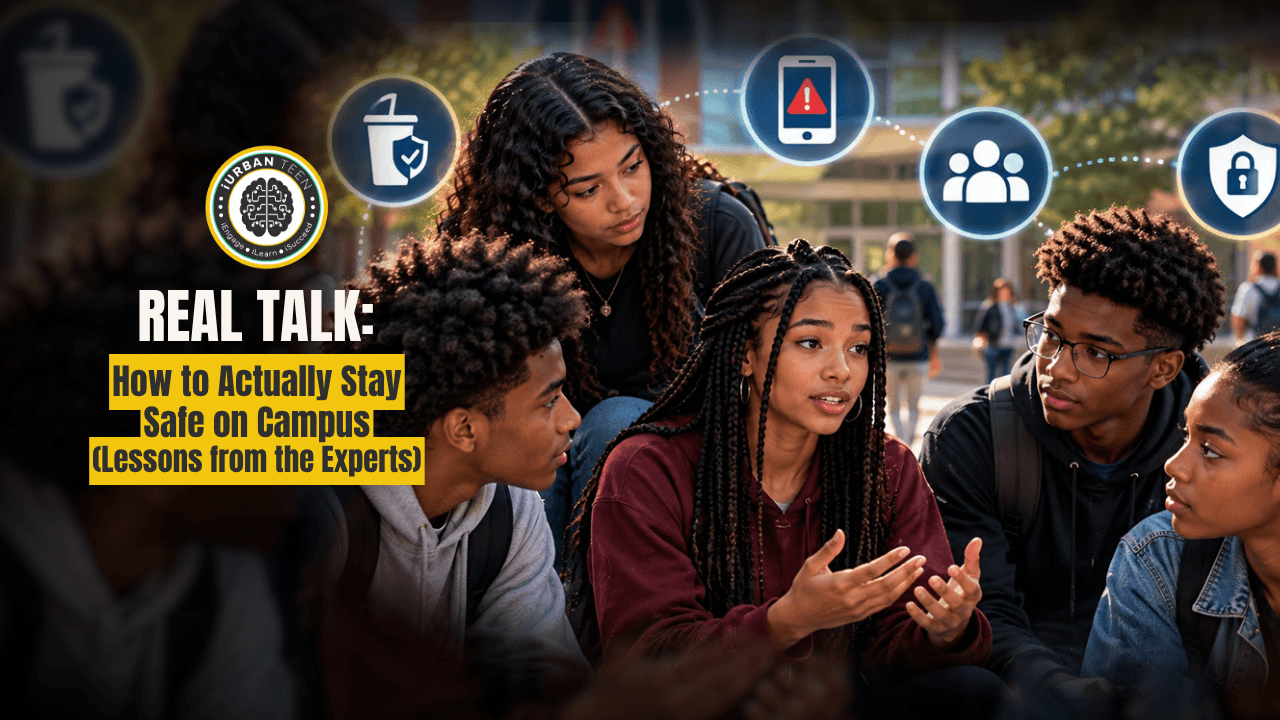
Every fall, millions of students head to college — many living away from home for the first time — and safety experts agree on one thing: preparation beats fear every time. “Safety isn’t about fear—it’s about preparation, empowerment, and action,” says Carrie Pasquarello, CEO of Global Secure Resources, speaking during National Campus Safety Month. Here’s what the professionals actually recommend, cutting through the noise.
Why iUrban Teen is spotlighting this now. Cornell University’s recently released 2026 Annual Security Report — mandated under the federal Clery Act — showed a mixed picture: reported on-campus rape and dating violence decreased, but stalking incidents and non-campus building rape reports increased. The report also reflects new federal hazing reporting requirements under the Stop Campus Hazing Act. Separately, Cornell has faced public scrutiny tied to a fraternity-related investigation involving allegations of drugging and sexual assault at off-campus events — a pattern of concern that isn’t unique to one school. It’s a sobering reminder for every family: campus safety isn’t abstract, and conversations about it shouldn’t wait until something happens.
Know your resources before you need them. The Texas Department of Public Safety puts it simply: save campus police and local emergency numbers in your phone now, and get familiar with emergency call boxes and safety apps during orientation — not during an actual emergency. NBC Senior Investigative Correspondent Vicky Nguyen echoes this, noting that most campuses now have a campus-wide alert system, and that in many situations, students should call campus police first, since they’re often faster to respond and more familiar with the specific location than a general 911 dispatch.
On drinking and parties: watch your drink, every time. Safety guidance following real campus drugging incidents is consistent and simple: if possible, watch how your drink is made and poured, never leave a drink unattended, and don’t accept an open drink from someone you don’t know well. Drugs like Rohypnol — a central nervous system depressant not approved for sale in the U.S. — are typically slipped into drinks and can cause incapacitation even when someone has had little to no alcohol, according to the U.S. Department of Justice. If you or a friend start feeling suddenly, unusually impaired, treat it as a medical emergency and get to campus safety or call 911 immediately — don’t wait it out.
“If you see something, say something” isn’t just a slogan. U.S. News & World Report’s campus safety coverage emphasizes that experts strongly encourage students to report suspicious behavior — an unattended bag, a vehicle slowly circling campus — rather than assuming someone else will. As one safety expert quoted in that coverage put it plainly: “Campus safety is a shared responsibility.” Many campus safety apps now include an anonymous reporting option specifically to make this easier — the same principle applies at parties: if a friend seems too impaired for how much they’ve had to drink, don’t brush it off.
Don’t let politeness override your instincts. Multiple safety resources flag the same counterintuitive habit: many students automatically hold doors open for the person behind them — but experts specifically advise against this if you don’t know the person, even though it can feel rude in the moment. Your safety takes priority over social niceness.
There’s real safety in numbers. Walking with others, especially at night or leaving a party, remains one of the most consistently recommended habits across virtually every campus safety resource. Most schools offer official escort services for students who need to walk somewhere alone after dark — professionals recommend using them rather than risking it solo. The same buddy-system logic applies to parties: go with friends, leave with friends, and check in with each other throughout the night.
Do your homework before move-in day. Michigan State University Extension recommends that incoming students and their families locate the campus safety office, learn the campus escort system, and review the suggested-route safety maps most schools provide. Every college is legally required to publish an annual security and fire safety report — reviewing it gives families real, campus-specific crime data rather than assumptions, including how a school specifically handles alcohol and drug policy violations, sexual assault response, and hazing.
Have the hard conversations early — and keep having them. Experts stress this isn’t a one-time “talk” before drop-off. As one safety-focused resource for parents puts it, if your student comes to you with something serious, the goal is to actually listen and engage, not just lecture — ongoing, two-way conversation works better than a single safety speech. That includes direct, non-judgmental conversations about parties, drinking, and what to do if something feels wrong — not just “don’t drink,” but “here’s what to do if you or a friend are ever in trouble.”
The bottom line for families: no campus is risk-free, and no single tip eliminates danger — but the experts are consistent that preparation changes outcomes. Knowing who to call, downloading the safety app before week one, watching your drink, walking with a friend at night, and actually reading the campus crime report are small steps that add up to real protection.
Sources:
- Carrie Pasquarello, CEO, Global Secure Resources — via MarketScale, “National Campus Safety Month: What Every Student and Parent Should Know”
- Vicky Nguyen, NBC Senior Investigative Correspondent — NBC News, “Safety tips for college students on campus”
- Texas Department of Public Safety, official press release (August 2026) — dps.texas.gov
- U.S. News & World Report, “How to Stay Safe on a College Campus”
- Michigan State University Extension, “Staying Safe at College” — canr.msu.edu
- Cornell University, 2026 Annual Security Report — via The Cornell Daily Sun, September 2026
- U.S. Department of Justice, Rohypnol drug facts
- CBS News / CNN, Cornell fraternity party suspension coverage